
MetaTrader Copy Trading Explained: How It Works, Risks, Technology, and How to Choose the Right System
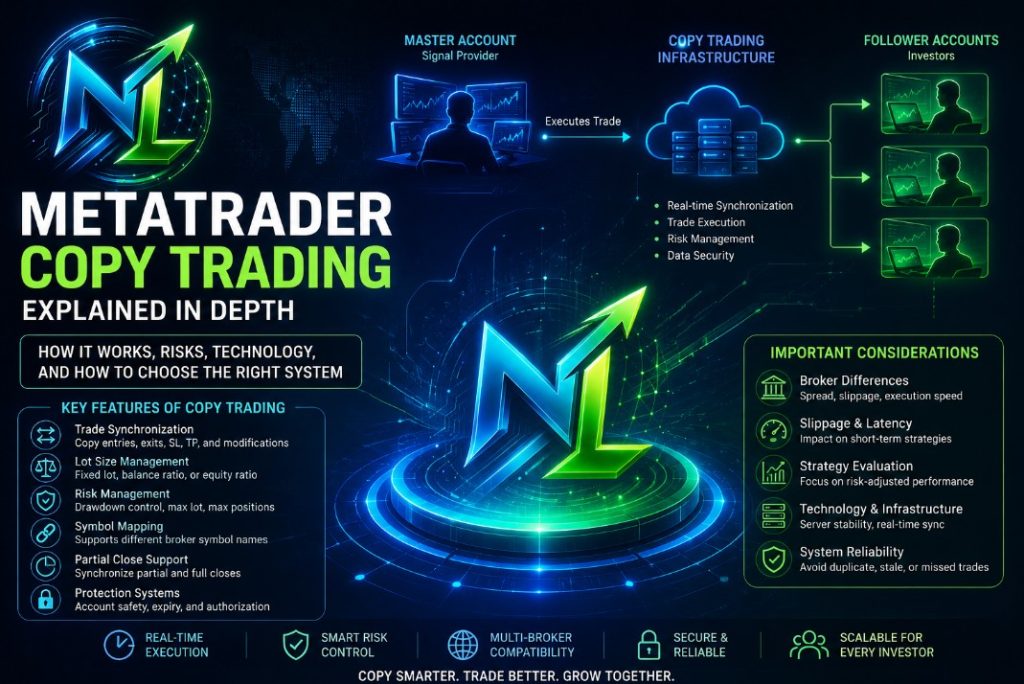
Copy trading has become one of the most accessible ways for traders and investors to participate in the financial markets without manually analyzing every chart or executing every trade themselves.
Through MetaTrader copy trading, investors can automatically replicate trades from another trading account, often referred to as the Master Account, Signal Provider, or Strategy Provider. The investor’s account, commonly called the Follower Account or Investor Account, then attempts to mirror the trading activity of the master account according to predefined settings.
However, professional copy trading is much more complex than simply copying a BUY or SELL order.
A properly designed MetaTrader copy trading system must deal with trade execution, account synchronization, lot calculation, broker conditions, latency, slippage, risk management, stop-loss and take-profit synchronization, partial closes, pending orders, multiple positions, and account protection.
This article explains how MetaTrader copy trading works in greater depth and what traders should understand before using such a system.
What Is MetaTrader Copy Trading?
MetaTrader copy trading is a system that allows trading activity from one MetaTrader account to be replicated automatically on another MetaTrader account.
The basic structure is:
Master Account → Copy Trading Infrastructure → Follower Account
When a trade is opened on the master account, the copy trading system detects the event and sends the trading instruction to the follower account.
For example:
The Master Account opens:
- Symbol: EURUSD
- Direction: BUY
- Volume: 1.00 lot
- Entry Price: 1.10000
- Stop Loss: 1.09500
- Take Profit: 1.11000
The Follower Account may receive the instruction and open:
- Symbol: EURUSD
- Direction: BUY
- Volume: 0.10 lot
- Entry Price: 1.10008
- Stop Loss: 1.09508
- Take Profit: 1.11008
The trade is technically copied, but the result may not be identical because of differences in account balance, broker pricing, spread, execution speed, and available liquidity.
This is one of the most important concepts in copy trading:
Copying a trade does not necessarily mean receiving the exact same trading result.
How Does MetaTrader Copy Trading Work?
There are several different architectures used to build a MetaTrader copy trading system.
1. Local Expert Advisor Copy Trading
In the simplest structure, both the master and follower accounts run on the same computer or VPS.
The Master EA monitors trading activity and writes trade information to a local file, memory, or communication channel.
The Follower EA reads this information and executes the corresponding trades.
Example:
Master MT5
    ↓
Master EA
    ↓
Local File / Shared Memory
    ↓
Follower EA
    ↓
Follower MT5
Advantages
- Simple architecture
- Low latency
- Does not necessarily require an external server
- Easy to deploy for personal use
Disadvantages
- Both terminals may need to run on the same machine
- Limited scalability
- Difficult to support a large number of follower accounts
- System failure can affect all accounts
This architecture is often suitable for personal account-to-account copying.
2. Server-Based Copy Trading
A more advanced architecture uses a central server.
The Master EA sends trading information to a server. Follower EAs then retrieve or receive that information.
The architecture may look like this:
Master MT5
    ↓
Master EA
    ↓
API / WebSocket / Server
    ↓
Database
    ↓
Follower EA
    ↓
Follower MT5 Accounts
The server can store information such as:
- Trade ID
- Symbol
- Direction
- Volume
- Entry price
- Stop loss
- Take profit
- Open time
- Close time
- Account status
- Strategy identifier
- Signal timestamp
This model is significantly more scalable.
A single master account can potentially distribute trade information to hundreds or thousands of follower accounts, depending on the infrastructure.
The Difference Between Signal Copying and Trade Copying
This distinction is extremely important.
Signal Copying
Signal copying means the master sends a trading instruction such as:
BUY EURUSD
The follower’s EA then decides how to execute the trade.
For example:
Master Signal:
BUY EURUSD
The follower system may execute:
BUY EURUSD 0.01 lot
or:
BUY EURUSD 0.10 lot
depending on the follower’s risk settings.
Trade Copying
Trade copying attempts to replicate the actual trading activity of the master.
The system may copy:
- Entry
- Lot size
- Stop Loss
- Take Profit
- Modification
- Partial close
- Full close
- Pending orders
For example:
Master:
BUY EURUSD 1.00 lot
SL: 1.09500
TP: 1.11000
The follower may copy:
BUY EURUSD 0.10 lot
SL: 1.09500
TP: 1.11000
Trade copying generally requires more sophisticated synchronization logic.
How Is the Lot Size Calculated?
One of the most important elements of copy trading is volume calculation.
The follower does not always use the same lot size as the master account.
There are several common models.
Fixed Lot Copying
The follower always uses a predefined lot size.
Example:
Fixed Lot = 0.01
Regardless of the master trade size, every trade opened by the follower uses 0.01 lot.
Example:
Master:
BUY EURUSD 5.00 lots
Follower:
BUY EURUSD 0.01 lot
Advantages
- Simple
- Easy to control
- Suitable for small accounts
- More predictable risk
Disadvantages
- Does not scale with account balance
- May produce very different performance from the master
Fixed lot copying is often suitable when the investor wants strict control over their own trading volume.
Balance-Based Lot Scaling
A more sophisticated method calculates the follower’s lot size based on account balance.
The basic concept is:
Follower Lot =
Master Lot × Follower Balance / Master Reference Balance
For example:
Master:
Master Lot = 1.00
Master Reference Balance = $10,000
Follower:
Follower Balance = $1,000
Calculation:
1.00 × ($1,000 / $10,000)
= 0.10 lot
The follower receives approximately 10% of the master’s trading volume.
This model allows the trade size to scale according to account capital.
Equity-Based Copy Trading
Balance is not always the best measurement.
A master account may have:
Balance: $10,000
Equity: $7,000
This means the account currently has $3,000 in floating loss.
If a follower calculates risk using balance only, the follower may copy trades with excessive risk relative to the master’s actual current equity.
Therefore, advanced copy trading systems may use:
Follower Lot =
Master Lot × Follower Equity / Master Equity
This may provide a more realistic representation of current risk.
Why Broker Differences Matter
Two traders can trade the same symbol but receive different results.
For example:
Master Broker:
EURUSD Ask: 1.10000
Spread: 0.8 pip
Follower Broker:
EURUSD Ask: 1.10012
Spread: 1.8 pips
The follower may receive a worse entry price.
This can become especially important for:
- Scalping
- News trading
- Gold trading
- High-frequency strategies
- Grid systems
- Short-term arbitrage strategies
The shorter the trading timeframe, the more important execution differences become.
A strategy that performs well on a master account may produce different results on a follower account due to:
- Spread
- Slippage
- Execution speed
- Liquidity
- Commission
- Swap
- Symbol specifications
Symbol Mapping Is a Critical Feature
Different brokers may use different symbol names.
For example:
| Master Symbol | Follower Symbol |
|---|---|
| EURUSD | EURUSDm |
| XAUUSD | GOLD |
| US30 | US30.cash |
| BTCUSD | BTCUSDm |
A professional copy trading system should support symbol mapping.
Example:
Master: XAUUSD
Follower: XAUUSDm
Without symbol mapping, the follower EA may be unable to open the trade.
This becomes especially important when copying trades between different brokers.
Why XAUUSD Copy Trading Requires Special Attention
Gold is one of the most popular instruments for copy trading, but it can also be one of the most difficult.
Different brokers may have:
- Different contract sizes
- Different point values
- Different minimum lot sizes
- Different spreads
- Different trading hours
- Different symbol names
For example, one broker may define:
XAUUSD
Contract Size: 100 ounces
Another broker may have different trading conditions.
The same 0.01 lot may therefore produce different financial exposure depending on the broker’s contract specifications.
A professional copy trading system should calculate risk using actual symbol specifications instead of blindly copying the master lot size.
Trade Synchronization: The Core of a Professional System
The biggest challenge in copy trading is maintaining synchronization.
Suppose the master account opens:
Trade ID: 12345
BUY EURUSD
The follower opens:
Trade ID: 98765
BUY EURUSD
The follower trade has a different ticket number.
The system must create a relationship:
Master Trade 12345
        ↓
Follower Trade 98765
If the master later modifies the stop loss:
Master SL:
1.09500 → 1.09700
The follower system must detect the change and update the follower position.
The relationship becomes:
Master Position
        ↓
Follower Position
        ↓
Follower Position
        ↓
Follower Position
This mapping is the foundation of reliable synchronization.
What Happens When the Master Closes a Trade?
A professional copy trading system must monitor the entire lifecycle of a trade.
Example:
Step 1: Master Opens
BUY EURUSD
Step 2: Follower Copies
BUY EURUSD
Step 3: Master Modifies Stop Loss
SL: 1.09500 → 1.09700
Step 4: Follower Updates Stop Loss
Follower SL: 1.09508 → 1.09708
Step 5: Master Closes Position
Master Position: CLOSED
Step 6: Follower Closes Position
Follower Position: CLOSED
This process is called trade lifecycle synchronization.
Partial Close Synchronization
Partial closes are often overlooked.
Suppose the master opens:
BUY 1.00 lot
Then closes:
0.50 lot
The master now has:
0.50 lot remaining
The follower must replicate this action proportionally.
For example:
Follower Original Position: 0.10 lot
The follower may close:
0.05 lot
and leave:
0.05 lot remaining
Without proper partial-close synchronization, the follower’s exposure may become different from the master.
Stop Loss and Take Profit Synchronization
Copy trading systems may use two different approaches.
1. Copy the Original SL/TP
The follower receives the same stop loss and take profit levels.
Example:
Master:
Entry: 1.10000
SL: 1.09500
TP: 1.11000
Follower:
Entry: 1.10010
SL: 1.09500
TP: 1.11000
2. Copy the Distance
The follower copies the distance from the entry price.
Master:
Entry: 1.10000
SL Distance: 500 points
Follower:
Entry: 1.10010
SL: 1.09510
This method can be more logical when the follower’s execution price differs significantly from the master’s entry.
The Problem of Slippage
Slippage occurs when the execution price is different from the requested price.
Example:
Master:
Requested Entry: 1.10000
Actual Entry: 1.10001
Follower:
Requested Entry: 1.10000
Actual Entry: 1.10025
The difference is significant for short-term strategies.
The system should therefore record:
Master Entry Price
Follower Entry Price
Execution Delay
Slippage Difference
This data can be used to measure copy trading quality.
Real-Time Copying vs Polling
There are two common methods of transferring trading information.
Polling
The follower periodically checks the server.
Example:
Every 1 second:
Check for new trades
Advantages
- Simple
- Reliable
- Easy to implement
Disadvantages
- Introduces delay
- Higher request frequency
- May create unnecessary traffic
Real-Time Event-Based Copying
The server pushes information immediately when a trade event occurs.
Example:
Master Opens Trade
        ↓
Server Receives Event
        ↓
Follower Receives Notification
        ↓
Follower Executes Trade
Technologies such as WebSocket-based communication can be used for near real-time data transfer.
This architecture is generally better for high-speed copy trading systems.
Why Internet Connection and VPS Matter
Copy trading depends heavily on uptime.
If the master terminal disconnects:
Master EA Offline
new trades may not be transmitted.
If the follower terminal disconnects:
Follower EA Offline
the follower may miss trades or receive them late.
For this reason, many professional systems use VPS hosting.
A VPS provides:
- 24/7 operation
- Stable internet connection
- Lower latency
- Continuous MetaTrader operation
- Reduced risk of local computer failure
However, a VPS does not eliminate all risk.
The system can still experience:
- Server outages
- Broker disconnections
- API errors
- Terminal crashes
- Network failures
Therefore, redundancy and recovery mechanisms are important for professional infrastructure.
The Importance of Idempotency
A professional copy trading system must prevent duplicate trades.
Imagine the master opens one position:
Master Trade ID: 1001
The follower receives the instruction but does not respond correctly.
The system retries the request.
Without proper protection, the follower might open:
Trade 1
Trade 2
even though the master opened only one trade.
A professional system should use a unique identifier:
Master Trade ID: 1001
Before opening a new trade, the follower checks:
Has Master Trade 1001 Already Been Copied?
If yes:
Do Not Open Duplicate Trade
This concept is known as idempotent execution.
It is one of the most important technical features in reliable copy trading.
What Happens If the Follower Misses a Trade?
A good copy trading system should have a recovery mechanism.
Suppose:
Master opens Trade A
but the follower is temporarily offline.
When the follower reconnects, it should request the current master snapshot.
The system can compare:
Master Open Positions
vs
Follower Open Positions
Example:
Master:
Trade A
Trade B
Trade C
Follower:
Trade A
Trade C
The system detects:
Trade B is missing
and can determine whether it should:
- Open the missing trade
- Ignore the trade because it is too old
- Reject the trade because the master has already modified it
- Synchronize the current position state
This is called state reconciliation.
Why Stale Trade Protection Is Important
Imagine the master opened a trade:
10:00:00
The follower was offline until:
10:30:00
The trade is already deeply in profit.
Should the follower still open the trade?
Not necessarily.
The system may define:
Maximum Snapshot Age = 120 seconds
If the trading instruction is older than the allowed time:
Reject Stale Trade
This prevents the follower from entering a trade too late.
However, the correct rule depends on the strategy.
For long-term swing trading, a 30-minute delay may not matter.
For scalping, even a few seconds can be critical.
Risk Management Is More Important Than the Master Strategy
Many investors focus only on the master’s profit percentage.
This can be dangerous.
A master account may generate:
+50% Return
but experience:
-40% Drawdown
A follower may not be psychologically or financially prepared for that drawdown.
Before copying a strategy, investors should analyze:
- Maximum drawdown
- Average drawdown
- Recovery time
- Maximum number of open positions
- Average trade duration
- Largest historical loss
- Exposure per instrument
- Use of leverage
- Use of grid or martingale strategies
A strategy with high returns but extreme drawdown may be unsuitable for many investors.
Copy Trading and Grid Strategies
Grid strategies require additional attention.
Suppose the master opens:
BUY 0.01
Then price moves against the position:
BUY 0.01
BUY 0.01
BUY 0.01
BUY 0.01
The follower must correctly copy:
- Number of positions
- Entry spacing
- Lot sizes
- Average price
- Take profit logic
- Stop loss logic
If the master uses:
Step = 500 points
but the follower broker has a different symbol specification, the actual distance must be calculated correctly.
Grid copying is therefore more complex than copying a single independent trade.
Copy Trading and Martingale Risk
Martingale strategies can increase trading volume after losses.
Example:
Trade 1: 0.01 lot
Trade 2: 0.02 lot
Trade 3: 0.04 lot
Trade 4: 0.08 lot
If the master uses aggressive volume multiplication, a follower with insufficient capital may experience a margin call much earlier than the master.
Therefore, the follower should have independent protection mechanisms such as:
- Maximum lot size
- Maximum open positions
- Maximum drawdown
- Maximum daily loss
- Equity stop
- Maximum margin usage
A copy trading system should never assume that the master’s risk profile is automatically suitable for the follower.
Account Protection Features
Professional copy trading systems often include account-level protection.
Examples include:
Maximum Drawdown Protection
Maximum Drawdown: 20%
If equity falls beyond the defined level:
Close Positions
Disable New Trades
Maximum Daily Loss
Maximum Daily Loss: 5%
If the account loses 5% in one trading day:
Stop Copying
Maximum Lot Protection
Maximum Allowed Lot: 1.00
Even if the master opens:
10.00 lots
the follower system rejects or limits the position.
Maximum Open Trades
Example:
Maximum Open Positions = 10
If the follower already has 10 positions, new trades may be rejected.
These protections allow the investor to maintain independent risk control.
Why the Master Account Should Not Be Judged Only by Profit
A master account can show an impressive return but still be extremely dangerous.
For example:
Return: +300%
Maximum Drawdown: -70%
Another strategy may show:
Return: +40%
Maximum Drawdown: -10%
The second strategy may be more sustainable for many investors.
Important metrics include:
Profit Factor
Measures gross profit compared to gross loss.
Maximum Drawdown
Shows the largest decline from peak equity.
Recovery Factor
Measures the relationship between net profit and maximum drawdown.
Sharpe Ratio
Measures risk-adjusted performance.
Sortino Ratio
Focuses more specifically on downside volatility.
Average Trade
Shows the average result per trade.
Maximum Consecutive Losses
Helps determine the capital required to survive losing periods.
The objective is not simply to find the highest return.
The objective is to understand the relationship between:
Return
Risk
Drawdown
Consistency
Recovery
MetaTrader 4 vs MetaTrader 5 Copy Trading
Copy trading can be implemented on both platforms.
MetaTrader 4
Advantages:
- Very widely used
- Large ecosystem
- Many existing Expert Advisors
- Popular among Forex traders
MetaTrader 5
Advantages:
- More advanced trading architecture
- Better support for modern market structures
- More powerful programming environment
- Improved handling of certain trading operations
- Better suitability for advanced infrastructure
The choice depends on:
- Broker support
- EA compatibility
- Strategy requirements
- Account type
- Infrastructure design
A professional copy trading platform may support both MT4 and MT5.
What Happens When Brokers Use Different Account Types?
Copy trading can become more complicated when the master and follower use different account types.
For example:
Master:
Standard Account
Follower:
Cent Account
or:
Master: Hedging Account
Follower: Netting Account
These accounts may handle positions differently.
For example, in a hedging environment:
BUY EURUSD
SELL EURUSD
can exist simultaneously.
In a netting environment, positions may be combined into a single net position.
This means the copy trading system must understand the account’s position model.
Blindly copying orders can produce incorrect results.
The Future of MetaTrader Copy Trading
Modern copy trading systems are increasingly moving beyond simple trade replication.
Future systems may combine:
- Automated risk adjustment
- AI strategy classification
- Portfolio allocation
- Multi-master diversification
- Dynamic lot sizing
- Real-time risk monitoring
- Drawdown-based risk reduction
- Automated strategy filtering
For example, a platform could automatically reduce copy volume when:
Master Drawdown Increases
and increase allocation when:
Risk-Adjusted Performance Improves
Instead of simply asking:
Should I copy this trader?
the system could ask:
How much of my portfolio should be allocated to this strategy?
This represents a more advanced approach to copy trading.
How to Choose a MetaTrader Copy Trading System
Before using a copy trading service, consider the following questions.
1. How is the trade copied?
Is the system using:
- Local communication?
- API?
- Server?
- WebSocket?
- Signal infrastructure?
2. What happens if the follower goes offline?
Can the system:
- Recover missed trades?
- Synchronize existing positions?
- Reject stale trades?
3. How is lot size calculated?
Does the system support:
- Fixed lot?
- Balance ratio?
- Equity ratio?
- Risk percentage?
4. Does it support different brokers?
Check:
- Symbol mapping
- Contract size
- Digits
- Point value
- Minimum lot
- Maximum lot
5. Does it synchronize trade modifications?
A complete system should support:
- Stop Loss changes
- Take Profit changes
- Partial closes
- Full closes
- Pending orders
6. What protection features are available?
Look for:
- Maximum drawdown
- Equity stop
- Maximum lot
- Maximum positions
- Daily loss limit
- Account authorization
- Expiry protection
Final Thoughts
MetaTrader copy trading is much more than simply copying BUY and SELL signals.
A reliable system must maintain synchronization between the master and follower accounts while dealing with real-world problems such as:
- Different broker conditions
- Slippage
- Execution delays
- Symbol differences
- Internet failures
- Missed trades
- Duplicate orders
- Partial closes
- Position modifications
- Different account balances
- Different margin requirements
The best copy trading systems combine three important elements:
Reliable Technology
+
Intelligent Risk Management
+
Consistent Trading Strategy
A powerful trading strategy alone is not enough.
A sophisticated copy trading infrastructure alone is also not enough.
The strongest system is one where the strategy, technology, execution, and risk management work together.
For investors, the most important lesson is simple:
Do not evaluate copy trading only by looking at profit. Evaluate the entire system, including how trades are executed, how risk is managed, and how the system behaves during unfavorable market conditions.
When these factors are properly understood, MetaTrader copy trading can become a powerful tool for accessing automated trading strategies while maintaining greater control over capital and risk.